Thousands of visitors have walked through the Michener Art Museum over the years without realizing they were standing on the grounds of the former Bucks County Jail.
Now, one of America’s most acclaimed contemporary artists is helping tell that story.
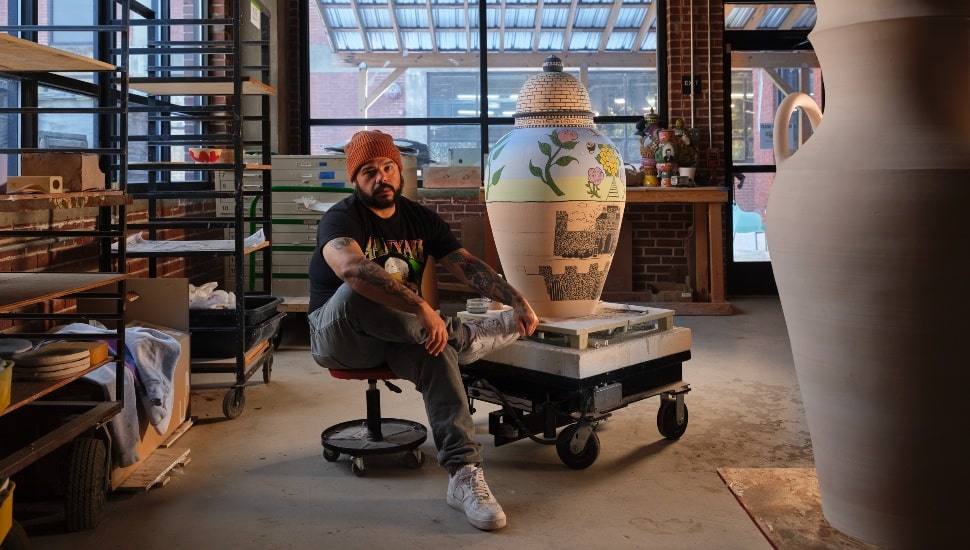
The Michener Art Museum will unveil Permanence: We Were Here on June 5, a newly commissioned work by Philadelphia artist Roberto Lugo that explores the transformation of the 1884 Bucks County Jail into one of the region’s leading cultural institutions.
The unveiling is part of the museum’s recognition of the 250th anniversary of the Declaration of Independence, but the artwork looks beyond traditional celebrations of American history.
Instead, it asks visitors to consider whose stories are remembered and whose are often left untold.
The commission was made possible through a state grant awarded by Pennsylvania Sen. Steve Santarsiero through the Commonwealth’s Department of Community and Economic Development.
The four-foot-tall ceramic vessel was created specifically for the Michener and will become part of the museum’s permanent collection.
The piece incorporates imagery from the museum’s architecture, the original stone prison walls that still surround portions of the property, and drawings created by incarcerated individuals who lived at the jail during the 1970s.
Those drawings originally appeared in the Pine Street Express, a magazine produced by people who were incarcerated there as part of a writing program facilitated by Vita Education Services.
“We are thrilled to unveil the artwork commissioned by Roberto Lugo for Michener Art Museum,” said Executive Director Anne Corso.
“The piece Permanence: We Were Here is timely as we honor our nation’s semiquincentennial, reflect on the history of our site as the former Bucks County Jail, and celebrate the role of contemporary craft in our collection.”
For many Bucks County residents, Lugo’s name may be unfamiliar. In the art world, however, he is one of the most recognized ceramic artists working today.
A North Philadelphia native, Lugo combines classical pottery traditions with influences from urban culture, portraiture, poetry, and social justice.
His work is in the permanent collections of institutions including the Metropolitan Museum of Art, the Los Angeles County Museum of Art, the Philadelphia Museum of Art, the Museum of Fine Arts Boston, and the Brooklyn Museum, among others.
The vessel draws inspiration from ancient Greek and Roman pottery. At its base are references to the former jail. Near the top, brightly colored imagery reflects the lives and voices of people who were once incarcerated there.
Museum curator Laura Igoe said the piece speaks to “overcoming systems of oppression while acknowledging and honoring the people who were incarcerated here.”
The commission builds on the Michener’s Behind These Walls initiative, a multi-year effort exploring the site’s former life as a correctional facility.
Community members involved in the project encouraged the museum to find ways to tell more of the building’s history through art.
For Lugo, the project offered an opportunity to tell a fuller version of the American story.
“So much of history is told from certain lenses and perspectives that don’t really tell everybody’s full truth,” Lugo said. “For me, this commission is profound because it’s telling a truth, uncovering history.”
When visitors encounter Permanence: We Were Here beginning June 5, they won’t simply be viewing a new piece of art.
They’ll be looking at a work that connects Bucks County’s past, present, and future, while reminding us that every place has stories hidden beneath the surface.
Permanence: We Were Here opens to the public Friday, June 5 at the Michener Art Museum, 138 South Pine Street in Doylestown.
Hours are Wednesday through Saturday, 10 a.m. to 5 p.m., and Sunday, noon to 5 p.m. Free for members, included with general admission.
Go see it.
The Michener is one of Bucks County’s great cultural treasures, and this is exactly the kind of exhibition that reminds you why.
Block off a morning or afternoon, bring someone who loves art or history or both, and plan to spend time with this piece. It rewards a slow look.
Plan your visit at michenerartmuseum.org.
.
__________