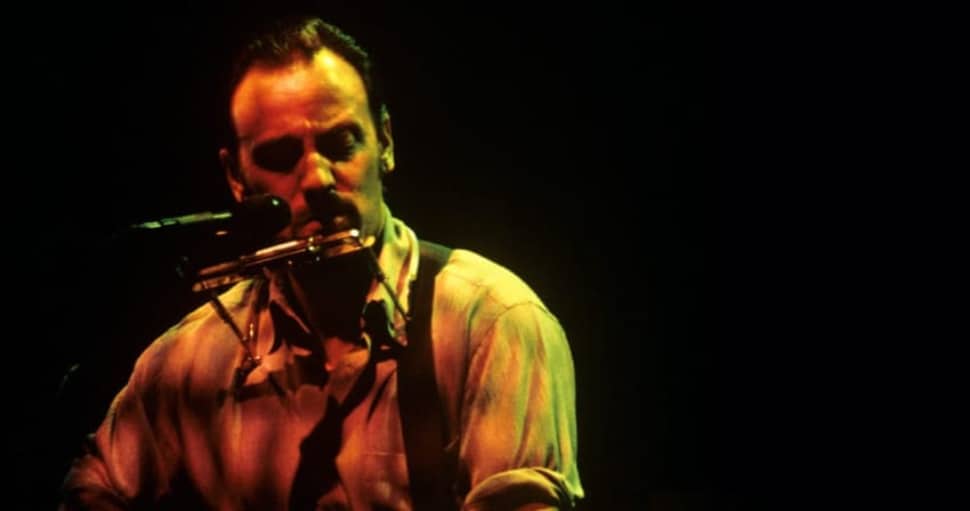
In October 1972, a little-known 23-years old musician from New Jersey took the stage at what was then known as West Chester State College and got four words from a stranger that summed up exactly where his career stood.
“That’s enough. That was it.”
Six songs in, Bruce Springsteen was tapped on the shoulder and told his set was over.
Cheech and Chong’s management had not been informed a third act was booked.
The comedy duo was the headliner. The unknown kid from Jersey was not.
Springsteen told the story himself decades later on Jimmy Kimmel, laughing at the memory. “People forget, but Cheech and Chong were huge, huge at the time,” he said.
“We came out, we played about five songs, I thought it was going really good. I was sitting at the piano and somebody tapped me on the shoulder and said, ‘That’s enough.’ That was it.”
The band that walked offstage that night at Hollinger Field House included saxophonist Clarence Clemons, bassist Garry Tallent, keyboardist Danny Federici, and drummer Vini “Mad Dog” Lopez.
Springsteen historians now cite the October 28, 1972 show as the earliest known public appearance of the group that would become the E Street Band.
It was not a great debut. But Philadelphia would more than make up for it.
Finding An Audience One Campus At A Time
The spring of 1974 became one of the busiest periods of Springsteen’s early career in the Philadelphia suburbs.
He played Widener College in Chester, Ursinus College in Collegeville, Archbishop Carroll High School in Radnor, and Bucks County Community College in Newtown.
College gyms. High school auditoriums. Whatever stage would have him.
The most significant of those shows came on April 28, 1974, at Scott Amphitheater on the campus of Swarthmore College.
The students who booked him paid $2,000. Fewer than 300 people showed up, drawn mostly by the fact that it was a free outdoor show on a warm spring afternoon.
“Bruce who?!” was the common response when the booking was announced, according to Stu Blair, the student who arranged it.
Those few hundred people may have witnessed something historic.
Many Springsteen researchers believe the Swarthmore audience heard the first documented live performance of Born to Run, the song that would eventually change everything.
A week later, Springsteen played Bucks County Community College in Newtown.
Less than three weeks after that, critic Jon Landau published his famous review declaring he had seen “rock and roll future” after a show in Cambridge, Massachusetts.
A young musician who had recently played a gym in Newtown was suddenly being called the future of rock and roll.
The Main Point Years
If one Philadelphia-area venue shaped Springsteen more than any other, it was The Main Point in Bryn Mawr, a small coffeehouse on Lancaster Avenue that no longer exists but looms large in Delaware Valley music history.
He first played there in 1973 and returned roughly 25 times over the next two years.
No other single venue saw that kind of commitment from him during this period.
The Main Point was intimate enough to showcase what was becoming his trademark: long, storytelling performances that made audiences feel like they were in on something the rest of the world had not figured out yet.
Philadelphia radio had figured it out.
On November 3, 1974, WMMR DJ Ed Sciaky hosted Springsteen for an in-studio interview and played “Born to Run” over the airwaves before the album existed.
It was the song’s radio debut. Springsteen later devoted a passage in his memoir to Sciaky and WMMR, titling it “A Deejay Saved My Life.” The Philadelphia audience that Sciaky helped build, Springsteen wrote, has stayed loyal ever since.
The most famous Main Point show came on February 5, 1975.
WMMR knew what it had. An internal memo instructed the station’s DJs to “promote this historic broadcast to death” before a single note was played.
That night, Springsteen and the E Street Band performed a nearly three-hour, 18-song benefit concert for the venue itself, a place that had given him a stage dozens of times when few others would.
Sciaky hosted the broadcast, introducing Springsteen by predicting he was about to “conquer America and the world.”
The concert included the earliest known live performance of Thunder Road, then still a work in progress called Wings for Wheels.
For Philadelphia listeners tuned to WMMR that night, it was a preview of an artist standing at the edge of something enormous.
The Move Into Philadelphia
While building his suburban following, Springsteen was also working his way into the city itself.
In November 1973, he played two shows at the Roxy Theatre on Sansom Street, touring behind his second album, The Wild, the Innocent and the E Street Shuffle.
He was still largely unknown outside dedicated music circles, but the Roxy represented a step up: a professional theater, a city audience, and a bigger stage than any college gym could offer.
The Tower Theater Breakthrough
The defining moment came at the Tower Theater in Upper Darby.
Springsteen first played there in September 1974. The show introduced audiences to a newly strengthened E Street Band featuring Roy Bittan and Max Weinberg, and The Philadelphia Inquirer took notice. Sold-out appearances followed before the year was out.
By December 1975, after Born to Run had turned him into a national star, Springsteen returned to the Tower for a run of concerts that culminated in a New Year’s Eve show closing the Born to Run tour.
The performance was later released officially as “Live at the Tower Theater, Philadelphia 1975,” a document of how far he had come and proof that Philadelphia had understood what it was watching long before the rest of the country caught up.
“Philadelphia has meant so much to us for such a long time,” Springsteen told a Philadelphia crowd in 2023.
He was not being gracious. He was stating a fact.
The Spectrum, And What It All Meant
The arc completed in 1976 when Springsteen reached The Spectrum.
The same fans who had seen him at Swarthmore for free, who had pressed into The Main Point on a February night to hear songs that did not have finished titles yet, were now watching him headline one of the city’s biggest arenas.
By then the secret was out. The rest of America had discovered Bruce Springsteen.
But Philadelphia got there first.
In campus gyms and outdoor amphitheaters, in a Bryn Mawr coffeehouse that is now gone, in an Upper Darby theater that released his concert as a live album, audiences across Chester County, Delaware County, Montgomery County, Bucks County, and Philadelphia had watched a transformation unfold in real time.
Before he was The Boss, Bruce Springsteen was simply a young musician who got tapped on the shoulder at West Chester State College and told his set was over.
What happened next became one of the greatest stories in rock history. And Philadelphia and its suburbs had a front-row seat.
_______
Bruce Springsteen reminisces about opening for Cheech & Chong at West Chester State College in a “small college town,” as Springsteen called it, at the 11:10-minute mark of the interview with Jimmy Kimmel.