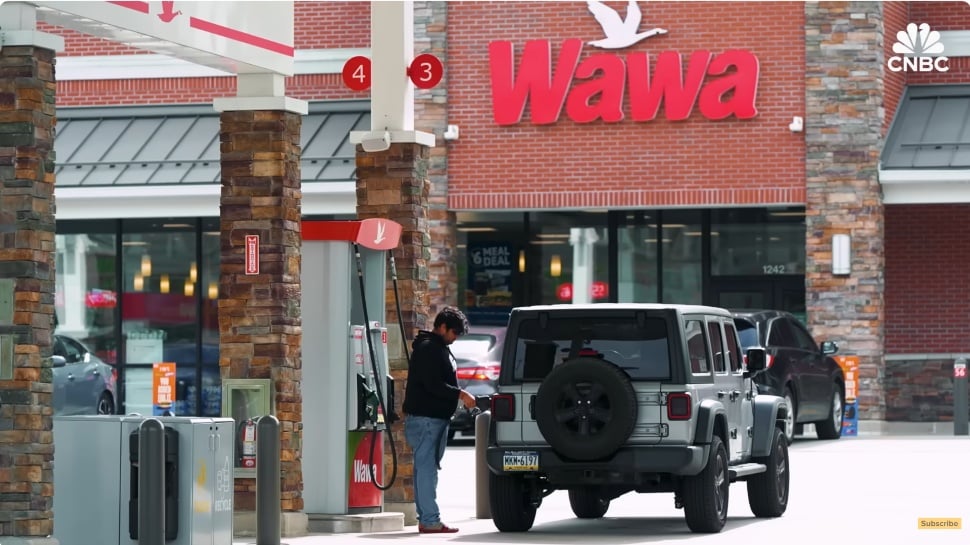
There’s a moment most people in the Delaware Valley know well. The car idles. The radio hums.
You’re not quite ready to go home, or you’re not fully awake yet, or you just need a minute before the next thing begins.
So you pull into Wawa.
Not because you planned to. Because it’s there.
That’s the quiet truth behind why Wawa is so deeply embedded in our culture and day-to-day life. It didn’t earn that place through clever slogans or flashy reinvention.
It earned it by becoming part of the rhythm of living here, by showing up in the in-between moments that make up most of a day.
Not just a convenience store, Wawa is something steadier
The Delaware Valley has no shortage of convenience stores. But Wawa functions differently. It isn’t simply a stop for gas or snacks. It’s emotional infrastructure.
You don’t walk into Wawa wondering what kind of experience you’ll have. You already know. The lighting. The smell of fresh coffee. The hum of the machines. The familiar rhythm of tapping through the open menu at the kiosk.
That predictability matters more than people realize.
In a region where life moves fast and schedules overlap, long commutes, split shifts, school drop-offs, caregiving, and second jobs, Wawa quietly removes friction.
One less decision. One less unknown. Just a cup of coffee that tastes the way it always does and takes about as long as you expect.
That reliability is why people default to it without thinking. And defaults shape daily life.
Where everyone has the same experience
Inside Wawa, the playing field flattens.
A corporate executive grabbing coffee between meetings stands in the same line as a construction worker finishing an overnight shift.
A teenager on her first solo drive waits behind a new college grad nervously scrolling through interview notes.
Someone from Delaware County picks up breakfast next to someone passing through from New Jersey.
Same door. Same prices. Same process.
No VIP line. No hidden signals about who belongs. For a few minutes, everyone is just another person moving through the same shared routine.
That quiet equality is rare—and it’s one of the reasons Wawa feels different from other convenience stores.
Built for the moments in between
Wawa is rarely the destination. It’s the place you end up.
On the way to work.
After practice.
Leaving the hospital.
Before a long drive.
Late at night, when everything else is closed.
Those in-between moments are where culture actually forms. Not at big events or planned outings, but in the pauses between them.
Wawa owns that space across the Delaware Valley, from central Pennsylvania to Arch Street in Philly, because it’s open when life doesn’t neatly fit into business hours.
That’s not an accident. From the first store to today’s sprawling network of Wawa stores up and down the east coast from Connecticut to Florida, the focus has always been on availability and consistency.
The result is a place people rely on without ever having to articulate why.
A regional rhythm you don’t think about, until it’s gone
Ask people where to meet and they’ll say, “the Wawa on Route 352” or “the one near the Downingtown Turnpike Exit.” No explanation needed.
Wawa has become a shared reference point, a kind of shorthand that works across towns and social circles.
That familiarity stretches across state lines and county borders, but it feels especially rooted in places like the Delaware Valley, where daily routines often revolve around short drives, packed schedules, and tightly connected communities.
Wawa fits into those patterns without asking to be the center of attention.
You don’t post about going to Wawa. You just go.
Small courtesies, repeated every day
There’s another reason Wawa feels human: the small interactions it encourages.
People hold the door a beat longer at Wawa. They nod. They exchange a quick smile. Not because anyone tells them to, but because the space allows for it.
There’s usually one main entrance. Everyone funnels through it. You notice the person behind you.
Those micro-moments don’t seem like much. But repeated thousands of times a day, across hundreds of stores, they reinforce something subtle: we’re all moving through this together.
In a world that often feels segmented and rushed, that matters.
Practical impact you can feel
Beyond culture, Wawa has a real, practical impact on the Delaware Valley.
It’s open when other places aren’t, serving shift workers, first responders, early commuters, and night owls.
It provides well-lit, staffed spaces late at night and early in the morning, places to regroup, make a call, grab food, or just not feel alone for a few minutes.
It also offers consistent access across neighborhoods, regardless of income level. The experience doesn’t change based on zip code.
The menu doesn’t suddenly feel out of reach. That kind of consistency quietly narrows everyday gaps people often feel elsewhere.
A training ground for adulthood
For many people, Wawa is where independence begins.
The first solo drive includes a Wawa stop. The first job commute starts with coffee from the same counter every morning. The first road trip without parents includes a late-night run for snacks.
Because the experience is low-pressure and predictable, Wawa becomes a safe place to practice navigating the world on your own. You learn how to order, how to pay, how to move through shared space. It sounds small, but it’s formative.
Rooted in history, adapted to the present
Wawa’s story didn’t start as a cultural phenomenon. It started as a dairy, shaped early on by people like George Wood, who helped guide the company’s growth and values.
Over time, the brand expanded, adapted, and modernized, introducing kiosks, expanded food options, and hundreds of locations, all without losing the core idea that made it work.
Even as menus changed and technology evolved, the experience stayed familiar. You still know what you’re getting. You still know how it works.
That balance, between evolution and continuity, is hard to pull off. Wawa did it by focusing less on novelty and more on trust.
Wawa is more than convenience
Wawa isn’t embedded in the Delaware Valley because it’s perfect. People argue about the food. They debate the coffee. They compare it to what it used to be.
But that debate itself is part of the culture.
People care because Wawa shows up in their lives every day. It’s there when plans fall through. When schedules run late. When you just need a cup of coffee and a minute to breathe.
In a region that’s changed quickly, economically, culturally, and physically, Wawa has remained familiar. And that familiarity gives people something steady to lean on without thinking about it.
For a few minutes at a time, inside a brightly lit store off a busy road, the Delaware Valley flattens out. We’re not titles or résumés or bank balances.
We’re just people grabbing what we need and getting on with our day.
_________
Ambient New York takes a Christmas Eve road trip to three Wawa stores, old-school to modern, to settle a timeless debate: what’s the most iconic Wawa item of all time, fueled by coffee, nostalgia, and very strong opinions.