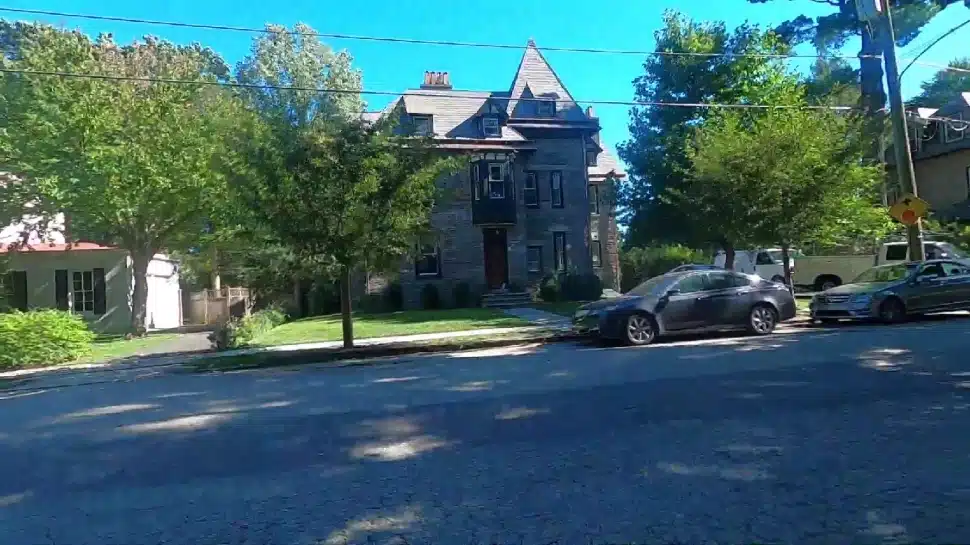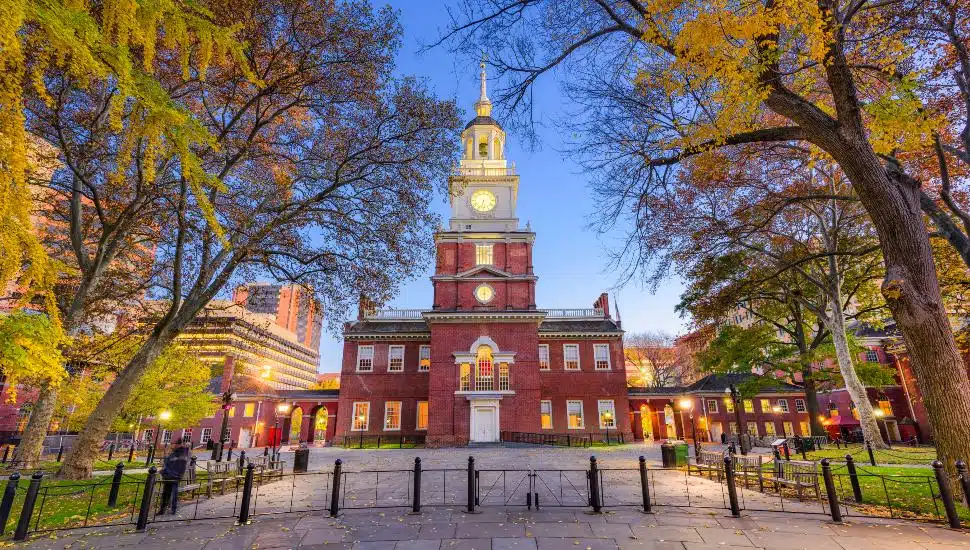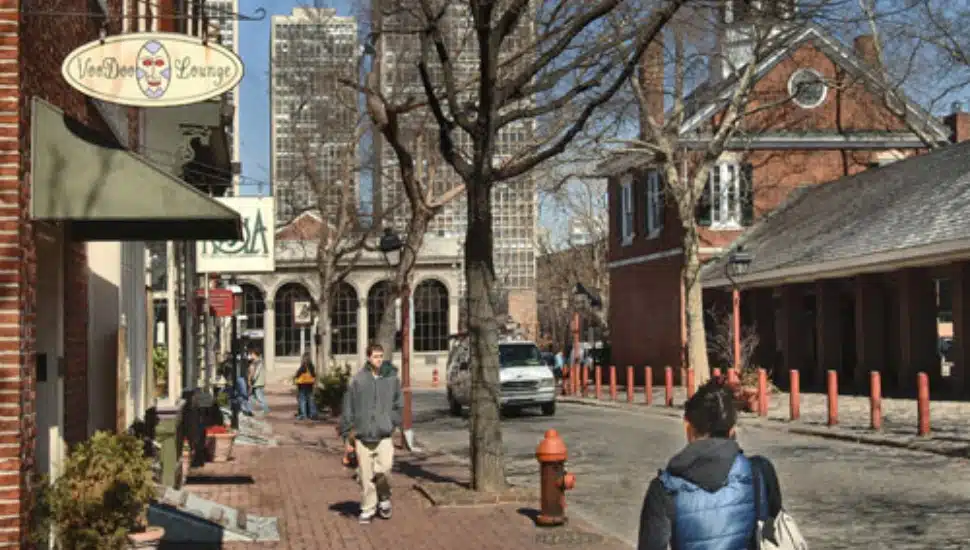
Society Hill looks like Philadelphia frozen in amber: gaslamp glow, marble stoops, brick laid two centuries deep.
But the real neighborhood lives somewhere past the cobblestones, writes Hanbit Kwon for Billy Penn at WHYY.
Long before colonial rowhouses claimed this ground, the Lenape called the stream running through it Cooconocon.
It still flows, technically, buried now beneath the curved sweep of Dock Street, a rare break in Philadelphia’s grid that traces water no one can see anymore.
The Delaware waterfront nearby tells a harder story, too: the same commerce that built Society Hill’s wealth also brought enslaved people ashore as early as 1639, a history etched into a marker most visitors walk past without noticing.
Walk the blocks today and the eccentricities pile up fast.
Angled “busybody” mirrors still hang from second-story windows, 18th-century tech for checking who’s at the door.
Cast-iron boot scrapers wait at the base of marble steps, holdovers from muddier streets.
Longtime resident Carole Abercauph remembers when this corner held a bakery, a dairy, a chicken store, before urban renewal smoothed the neighborhood into something quieter.
“A little staid,” she calls it now, not unkindly.
Yet stillness isn’t the whole story.
Kids climb the bronze bears at Three Bears Park until they shine.
Sunday crowds pack Headhouse Farmers Market under its 18th-century colonnade, haggling over tomatoes the way merchants once haggled on the same ground.
Coffee shops double as informal town halls.
Society Hill isn’t a museum piece. It’s a neighborhood that happens to be old, still arguing, still gardening, still very much alive.
For more on how everyday life still animates one of Philadelphia’s oldest neighborhoods, visit Billy Penn at WHYY.
_____