
It’s hard to imagine any college doing a better job of preparing its students for a career in social work than Gwynedd Mercy University.
GMercyU is a Catholic school rooted in the tradition of the Sisters of Mercy, a religious order of women who serve the poor, sick, and uneducated.
“The Sisters of Mercy are essentially social workers, and the mission of our university is social-justice-oriented,” said Janice Nuss, an Associate Professor and the Director of Field Education for GMercyU’s Bachelor of Social Work (BSW) Degree program. “A GMercyU education provides future social workers with the professional skills to make an impact in a life, in a community, and in the world with values rooted in dignity and respect for all people.”
March is National Social Work Month, a time to celebrate social workers and educate the public about what they do, the value they bring to society, and the many fields they work in.
Social workers support countless individuals — not just in the child welfare system, which is most often portrayed in the media — and assist in hospitals, public clinics, and various community settings. However, there is an alarming gap between the growing demand for their services and the availability of social workers to meet this need.
The demand for social workers is projected to grow faster than the average for all occupations, with the U.S. Bureau of Labor Statistics projecting a seven percent increase in employment from 2023 to 2033, leading to about 67,300 openings annually.
GMercyU’s BSW program combines classroom instruction with hands-on learning, giving students the tools to serve in a wide range of settings, including hospitals, schools, mental health centers, and social service agencies.
“The skills of a social worker are transferrable to a variety of settings,” said Nuss. “It starts with empathy, understanding the client, their walk of life. Then, social workers need to have the skills to express that empathy.”
Students in the program participate in simulated counseling sessions before beginning internships, allowing them to practice active listening, client validation, and care planning.
“We simulate counseling settings so students can build their skills before they go into the field,” Nuss said. “We also bring in community-based social workers to share their experience and help students develop practical plans of care.”
Internship opportunities are built into the program and designed to prepare students for the workforce. Many students secure certifications during their internships, and a growing number are hired directly by their internship sites. In fact, since 2020, 98 percent of GMercyU’s social work graduates have been employed in the field or enrolled in graduate school at the time of their graduation.
“Last year, 35 percent of our seniors were hired by the agencies where they interned,” Nuss said. “We’re strengthening our partnerships to make the transition from education to employment more seamless.”
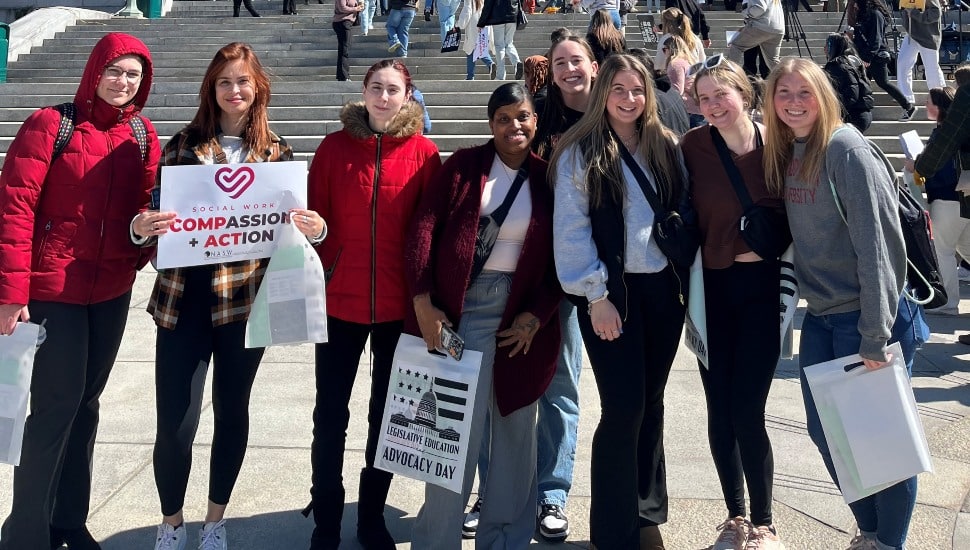
GMercyU students are also learning how to advocate for policy change. A group of students recently traveled to Harrisburg for a Legislative Education and Advocacy Day (LEAD) event, where they met with lawmakers to discuss bills affecting the profession, including the Social Work Licensure Compact, which would allow licensed social workers to practice across state lines.
“There’s a real workforce shortage, and the profession needs more visibility,” Nuss said. “Social workers are needed in hospitals, veterans’ services, behavioral health, and many other areas.”
GMercyU also provides students with global learning experiences, including service trips to Jamaica and Haiti in collaboration with the university’s nursing program. These trips expose students to different healthcare systems and community support models.
“We want students to understand social justice issues not just locally, but globally,” Nuss said. “It gives them a broader perspective on how social work can be applied in different settings.”
Learn more about how Gwynedd Mercy University is building a pipeline between its social work program and the workforce.