A teacher who drives 45 minutes to get to work. A nurse priced out of the neighborhood where she spends her shifts. A police officer who can’t afford to live in the community he patrols.
These aren’t hypothetical scenarios. They’re the lived reality behind Montgomery County’s first-ever affordable housing blueprint, unveiled this week by county leaders who say the region’s long reputation as a place where families plant roots and build careers is now under serious threat.
The Numbers Tell a Troubling Story
The numbers are stark, writes Ryan Mulligan for The Philadelphia Business Journal. The county’s median home sale price has rocketed from $310,000 in 2019 to $457,000 in 2024, a 47% jump in five years.
Over that same period, new housing production didn’t rise to meet demand. It collapsed, falling by 41%. Meanwhile, more than 21,000 new residents arrived between 2020 and 2025, all of them competing for a housing stock that was already stretched thin.
The result: nearly half of all renters in Montgomery County are now considered housing-cost burdened, meaning they spend more than 30% of their income just keeping a roof over their heads.
“We wanted to be able to do anything we could at the county level in order to help people not only afford a home but afford to get by,” said Commissioner Neil Makhija.
A Bold Blueprint With Real Teeth
The blueprint is an attempt to reverse what has quietly become a generational problem. Its central target is ambitious: 2,000 new housing units per year.
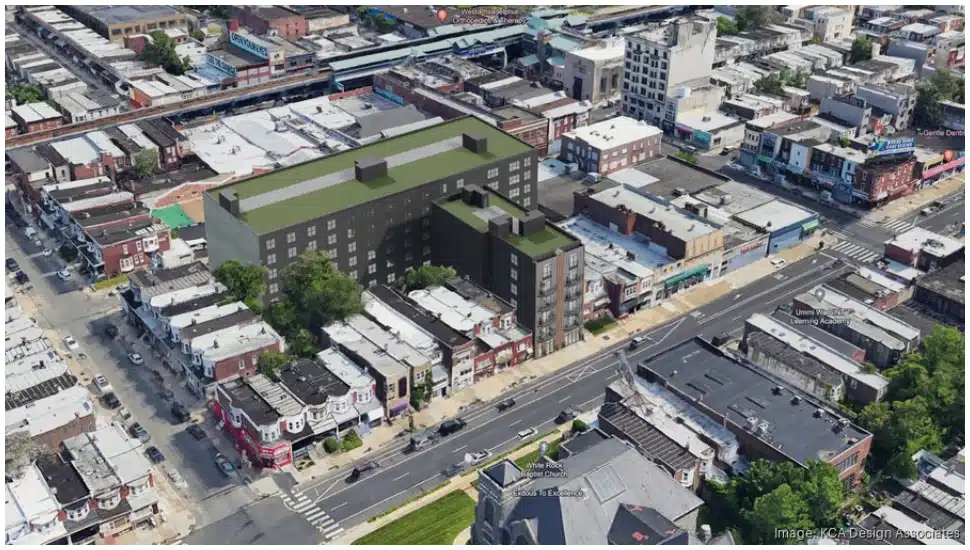
They will come through a combination of affordable housing developments, transit-oriented projects, and the adaptive reuse of underutilized commercial properties.
Officials are also exploring a land bank mechanism that would give the county a tool to redevelop vacant storefronts and office buildings into housing. The strategy has gained traction in post-pandemic metros grappling with the same hollowed-out commercial corridors.
The effort isn’t starting from zero. Projects are already in motion in King of Prussia, Norristown, Hatfield, Lower Merion, and Upper Gwynedd. This signals that the blueprint has operational momentum behind it, not just policy ambition.
County Commission Chair Jamila Winder made clear that incremental progress won’t be enough. “These are real, aggressive goals that we have,” she said, “and we’re going to continue to push the envelope.”
This Crisis Has Climbed the Income Ladder
What gives the crisis particular urgency is who it’s affecting. This is no longer solely a story about the county’s lowest-income residents, though they remain the most vulnerable.
The housing squeeze has climbed the income ladder and is now pressing hard on the workforce that keeps the county running. Teachers, nurses, first responders, and young professionals who grew up here and expected to stay all feel the pressure.
What’s at Stake for Montgomery County
Montgomery County has long marketed itself on the strength of its schools, its communities, and its quality of life. The housing blueprint is, in many ways, a bet that those things are worth fighting to preserve, and an acknowledgment that without serious intervention, the people who make the county function may no longer be able to afford to live in it.
Whether 2,000 units a year is enough to turn the tide remains to be seen. But for the first time, Montgomery County has a plan. Now it has to execute.
To learn more about Montgomery County’s strategy to add more affordable housing, visit The Philadelphia Business Journal.