
After spending a month living inside the stories and settings of the American Revolution and riding the excitement around Ken Burns’ new series (Now streaming for free for the next three weeks on PBS), it feels right to shift from watching history to walking through it.
One of the remarkable things about living in Southeast Pennsylvania is that the Revolutionary War isn’t distant or theoretical.
It’s local. It’s physical. And it’s right outside our back door.
Just a few minutes down the road, you can stand on the same fields, walk into the same rooms, and look across the same rivers where the early struggle for independence played out.
And if you’ve never explored these sites in winter, you’re missing something special.
Winter strips these places down to their essentials. The leaves drop, the crowds thin, and the atmosphere shifts. You see the landscape the way the soldiers and ordinary people back then saw it.
You feel the cold. You sense the vulnerability. The history becomes real.
Here are five Revolutionary War sites every local should visit this winter — plus one bonus destination that completes the story.
1. Valley Forge National Historical Park – At its best in the quiet of early winter
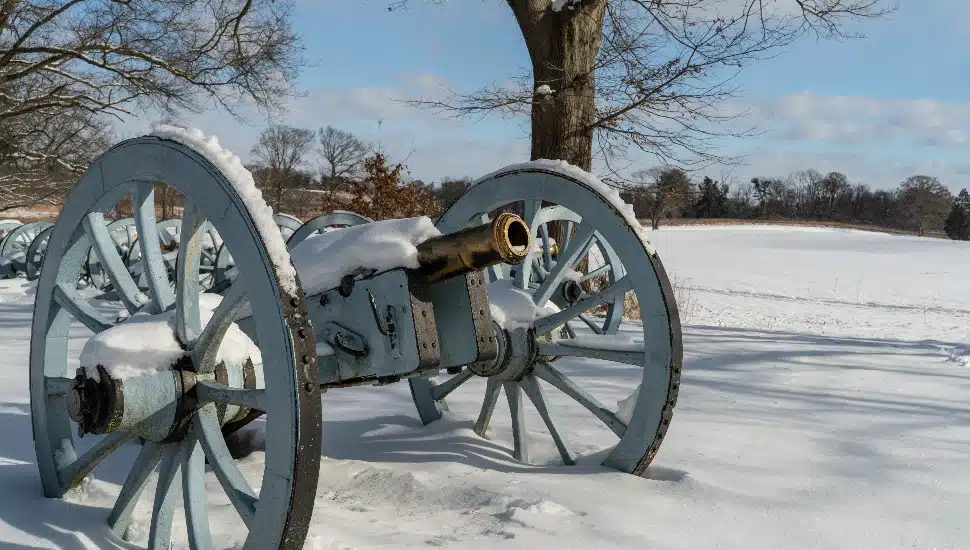
Valley Forge is beautiful year-round, but winter brings the park closer to its 1777–78 reality than any other season.
Once the trees are bare, the ridgelines, encampment fields, and huts feel stark, exposed, and honest.
You can see the contours of the land that shaped the army’s winter encampment. You can sense the cold that seeped into every cabin and every conversation.
And when you stand outside Washington’s Headquarters or walk through the reconstructed huts, the stillness gives you a small glimpse of what those months must have felt like.
Winter doesn’t just change the scenery. It changes the way you understand the place.
2. Washington Crossing Historic Park – The Christmas Day crossing reenactment
Every December 25th, hundreds of people gather along the Delaware River to watch something that never loses its magic: the reenactment of George Washington’s daring 1776 Christmas night crossing.
The Durham boats, the uniforms, the cadence of the commands, everything is done with extraordinary historical detail.
The entire riverbank goes quiet as the first boat pushes off. For a moment, you feel the weight of that desperate gamble and the courage it took to attempt it.
If Christmas morning crowds aren’t your thing, the dress rehearsal held earlier in December offers the same experience with easier parking and more space along the river.
Either way, it’s one of the most powerful living-history traditions in the region.
3. Museum of the American Revolution – The best indoor Revolutionary experience, maybe in the entire country
Few museums anywhere tell the story of the Revolution as well as this one. Instead of a collection of artifacts, the Museum of the American Revolution gives you a narrative, immersive galleries, dynamic exhibits, and deeply emotional storytelling that pulls you into the flow of events.
The highlight is George Washington’s War Tent, displayed with such care and reverence that many visitors walk out in stunned silence.
The museum also tells the stories of people often left out of the founding narrative: women, free and enslaved Black Americans, Native nations, immigrants, and Loyalists.
If Revolutionary November left you wanting more, this is where those questions get answered.
4. Brandywine Battlefield Park – Winter reveals the battlefield
The Battle of Brandywine was the largest land engagement of the entire war, yet it’s easy to miss the scale when the trees are full. Winter changes that.
The leaves are down, the sightlines open, and the terrain finally tells the story.
You can see the high ground the British used, the flanking routes Cornwallis followed, and the fields where Washington’s Army held and fell back.
The quiet makes the site feel more reflective, more serious, and more connected to the events of September 1777.
If the Ring House and Gilpin House are open when you visit, step inside. The smaller crowds of winter make those tours feel more personal.
5. Fort Mifflin – Atmospheric, underrated, and unforgettable in winter
Fort Mifflin doesn’t get the attention it deserves, but winter might be the best time to experience it.
The cold wind coming off the Delaware, the long shadows on the stone walls, the empty parade ground, the whole place feels closer to its 1777 siege, when Continental defenders held out under one of the heaviest bombardments of the war.
Winter programming is excellent too, from candlelight tours to living-history days in the casemates.
And then there are the low-flying airplanes from the Philadelphia airport. Visitors are often surprised by how the rumble overhead enhances the experience instead of interrupting it.
For a moment, you feel the echo of cannon fire, the thundering of bombardment, and the strange continuity of a place that has lived through more than two centuries of noise.
BONUS: Hagley Museum & Library – The next chapter of the Revolutionary story
Hagley may not be a Revolutionary battlefield, but it belongs on this list because it tells the part of the story that came after independence.
The young United States had to figure out how to survive without British industry or supply chains.
Gunpowder shortages nearly cost the Patriots the war, and decades later, E.I. du Pont built his powder works along the Brandywine to solve the ongoing national problem of production and supply.
Hagley is where political independence turns into economic independence.
It’s the bridge from fighting for a nation to building one.
Ken Burns’ Revolutionary War Lives Here — Even in Winter
Revolutionary November may be drawing to a close, but these local parks and museums remain open, accessible, and deeply meaningful this time of year.
Winter sharpens the history, quiets the scenery, and pulls you closer to the stories we’ve been exploring all month.
Bundle up, take a short drive, and go stand where the Revolutionary War still echoes.
________
Editor’s Note: This post first appeared on PHILADELPHIA Today in November 2025.