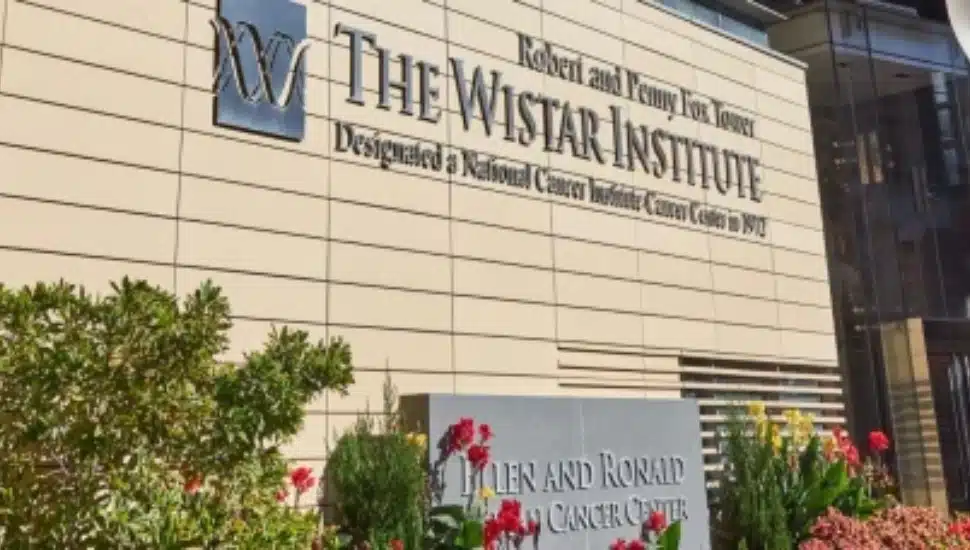

In September 2025, The Wistar Institute announced the opening of its new Center for Advanced Therapeutics (CAT).
The goal of the new center is to harness the power of Wistar science and speed creation of new medicines for human health.
The Center for Advanced Therapeutics is led by Paul Lieberman, Ph.D., and capitalizes on a history of groundbreaking Wistar research in cancer, immunology and infectious disease.
“Wistar had always been dedicated to the idea that fundamental biomedical research could be translated into practical new therapeutics and cures,” Lieberman said.
Wistar’s history of developing vaccines includes those used today for diseases like rubella, rabies, rotavirus, and more.
The opening of the CAT is just a continuation of Wistar’s long history of groundbreaking research in cancer, immunology, and infectious disease.
Lieberman, who has been with Wistar for more than a quarter-century, is a leading expert in the field of Epstein-Barr virus (EBV) research. EBV is found in almost 95 percent of humans and typically remains silent/latent but can awaken/activate and lead to certain cancers and autoimmune disease, particularly multiple sclerosis and lupus.
Lieberman studies the scientific interactions & factors of EVB and translates this science to develop antiviral therapies against EBV. The CAT expands on Lieberman’s idea of research towards clinical benefit—its mission is to bring together research & development of new therapeutics into potential and novel drug therapies.
“Over the years, Wistar and other collaborators in our life science sector have been tremendously supportive in helping to advance our conceptual understanding of the biology into a new therapeutic strategy to treat latent infection,” said Lieberman. “With the CAT we are integrating Wistar’s world-class, fundamental research and translational research toward clinical benefit.”
The launch of CAT is part of Wistar’s mission to help move early-stage discoveries into clinically relevant applications.
“We’re recruiting scientists with advanced computational capabilities of identifying molecular structures with promising druglike properties and using artificial intelligence and computational chemistry to screen not just hundreds of thousands but many millions of compounds as potential drug candidates,” Lieberman said. “And that is only enabled by the power of advanced machine learning and computation.”
He added that the center has a tripartite research focus: understanding how viruses contribute to autoimmune diseases; understanding cancer more broadly, particularly how certain viruses can induce cancers; and understanding how the immune system controls cancer.
The CAT was funded through a $30 million gift from an anonymous donor, along with a $1 million Pew Charitable Trusts grant to recruit staff.
“We certainly envision the center as being an important model to inspire our scientific community with the research freedom to carry out collaborative, early-stage drug discovery and supporters can provide either philanthropy or other ways of advancing this vital collaboration that hopefully saves lives,” Lieberman concluded.
To learn more about Wistar’s new Center for Advanced Therapeutics and its mission, visit https://www.wistar.org/center-for-advanced-therapeutics/