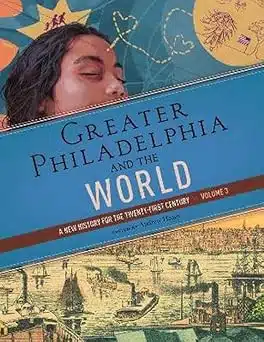
The following is an excerpt from Greater Philadelphia and the World (Vol.3), the third of a three-volume book series.
The Greater Philadelphia: A New History for the Twenty-First Century book series, edited by Carolyn T. Adams, Howard Gillette Jr., Andrew Heath, Charlene Mires, and Jean R. Soderlund, celebrates the role Philadelphia has as the nation’s beating heart, and unearths many of the nation’s hidden histories, points, of pride, as well as the people, places, and communities in the city.
It is informed by current scholarship and richly illustrated with full-color photographs and maps, bringing the public an up-to-date, diverse history of Philadelphia across its various dimensions.
The three volumes offer a fresh, engaging, and inclusive retelling of the Philadelphia region’s history from both leading scholars and local voices.
This excerpt, taken from Page 68 of Greater Philadelphia and the World (Vol.3) was written by Christian DuComb, and provides a brief history of the Mummers Parade in Philadelphia:
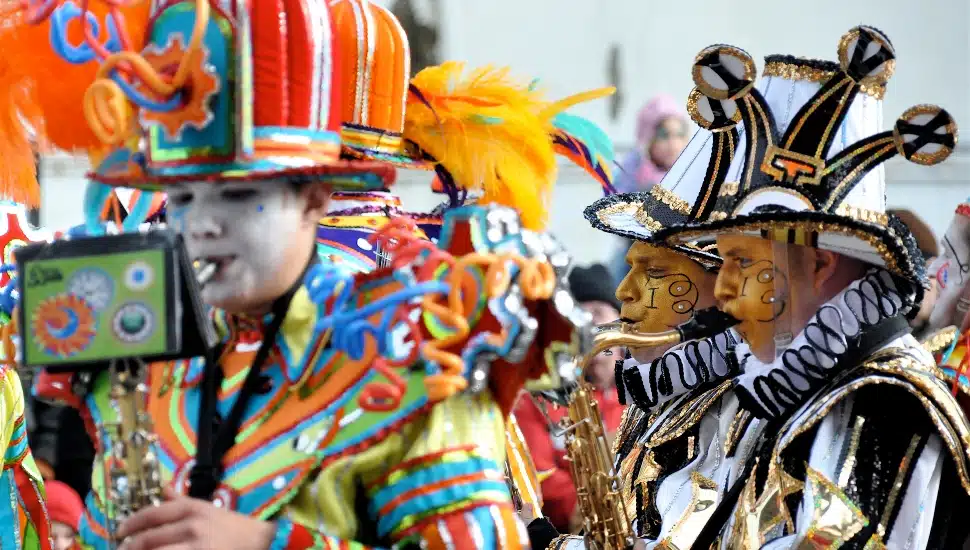
The Mummers Parade, an institution in Philadelphia since 1901, brought together many of the loosely organized groups of folk performers who roamed the streets each year between Christmas Eve and New Year’s Day. Known variously as mummers, shooters, belsnickles, fantasticals, and callithumpians, these masqueraders traced their roots to immigrants from England, Sweden, and Germany who introduced mumming to prerevolutionary Philadelphia.
Throughout much of northern Europe and colonial North America, groups of mummers roved from house to house during the Christmas season, entertaining their hosts and expecting food, drink, or a small tip in return. Mumming and belsnickling in southeastern Pennsylvania persisted into the 1800s, not only in Philadelphia but also in smaller cities like Easton, Lancaster, Pottstown, and Reading.
Most nineteenth-century mummers were young, working-class men, and their street-side antics could be raucous. According to the Philadelphia Public Ledger, New Year’s Day 1876 witnessed impromptu parades by men dressed as “Indians and squaws, princes and princesses, clowns . . . [and] Negroes of the minstrel hall type.”
Philadelphia’s new, central police force eventually cracked down on unruly holiday celebrations, and H. Bart McHugh—a newspaper reporter and theatrical agent—led the effort to bring the mummers to Broad Street for an organized parade, with prizes funded by the city. In 1901, the City of Philadelphia sponsored the first official Mummers Parade, and the Public Ledger reported that “three thousand men and boys in outlandish garb frolicked, cavorted, grimaced, and whooped while the Mayor and members of Councils, Judges, and other officials, State and municipal, looked on.”
From the beginning, most mummers clubs specialized in comedy, music, costume, or dance, leading to an elaborate structure for judging a varied assortment of parade performances that included clowning, string bands, elaborate costumes, burlesque impersonation (the “wenches”), and Broadway-style staging and choreography.
Until World War II, a plurality of mummers hailed from South Philadelphia, especially from the neighborhood’s Irish American and Italian American enclaves. Kensington and Port Richmond were also well represented in the early twentieth-century Mummers Parade, and beginning in the 1950s, mummers clubs sprang up throughout the region, especially in Northeast Philadelphia and the New Jersey suburbs.
African American mummers regularly competed for prizes on Broad Street between 1901 and 1929, and African American composer James Bland wrote the parade’s unofficial theme song, “Oh, Dem Golden Slippers.” However, the mummers in later years developed a reputation for racial insensitivity.
Many mummers marched in blackface makeup until the city banned the practice following civil rights protests organized by Cecil B. Moore and the Philadelphia chapter of the NAACP in 1963. In the early decades of the twenty-first century, blackface still appeared at the nighttime party on “Two Street” after the official parade, and both the burlesque wench costume and the mummers’ strut (the signature dance step of the parade) originated on the minstrel-show stage. In 2013 the Joseph A. Ferko String Band celebrated the mummers’ connection to minstrelsy with a controversial parade routine titled “Bringin’ Back Those Minstrel Days,” performed in brown rather than black makeup to avoid censure by the judges.
Despite its troubled racial history, the Mummers Parade grew considerably more diverse and inclusive after 1963. In the 1970s most mummers clubs began admitting women as performers for the first time. Women had long worked behind the scenes, helping to stitch the mummers’ costumes, and one woman—a newspaper reporter named Laura Lee—snuck into the parade in 1929.
In 1984 the Goodtimers Comic Club, with an African American president and hundreds of minority members, started competing in the parade. And in 1992 a group of Cambodian American artists and students teamed up with the Golden Sunrise Fancy Brigade to stage a Khmer dance drama on Broad Street. At the behest of the Philadelphia Human Relations Commission, the 2016 Mummers Parade included a new, noncompeting unit called the Philadelphia Division, organized with the explicit goal of making the parade more diverse. Participants included a Mexican American carnival organization, an African American drill team, a Puerto Rican bomba group, and a brigade of drag queens. Although most mummers clubs embraced the growing diversity of the parade, reports of individual marchers using racist and homophobic slurs along the parade route complicated efforts to make the Mummers Parade more inclusive.
Despite challenges from cuts to public funding and the closure or consolidation of clubs, the mummers maintained a strong record of resilience into the new millennium. Since 1901 the Mummers Parade has been canceled only thrice, in 1919, 1934, and due to the COVID-19 pandemic in 2021.
To adapt, though, the parade route has changed at various points. In 2015, for instance, it reversed course to begin at the city hall judging stand and proceeded southward along Broad Street. (The wenches opted out of this route change, insisting on a traditional northward march). This literal change in direction reduced the gaps between performances at popular viewing spots in Center City, boosting the size of the crowds and demonstrating the mummers’ willingness to adapt to the evolving tastes—and shortening attention spans—of the twenty-first century.
Excerpted from Greater Philadelphia and the World (Vol.3) written by Christian DuComb and reprinted with the permission of Penn Press.