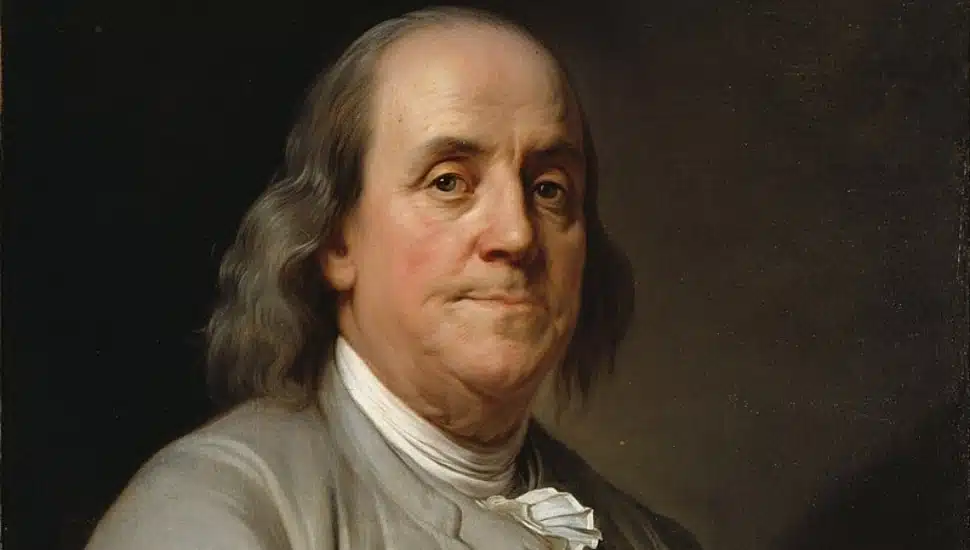

Benjamin Franklin’s story usually begins with the famous scenes: the lightning rod, the Pennsylvania Gazette, the founding of the American Philosophical Society, or the long table at the Second Continental Congress where he sparred with John Adams and later helped shape the Declaration of Independence.
But the story really starts much earlier, in a cramped wooden house on Milk Street in Boston, where a curious, restless boy named Ben began to understand what he wanted — and just as importantly, what he couldn’t tolerate.
He grew up as the 15th child of Josiah Franklin, a candle- and soap-maker who believed deeply in discipline, thrift, and hard work. In most families, that would’ve been enough to shape a life.
But young Ben Franklin wasn’t most children. He was the kid who tore through books, questioned sermons, and built little experiments along the waterfront.
He only had two years of formal schooling, yet he learned more from borrowed books than many learned in a lifetime.
At age 12, Franklin’s father apprenticed him to older brother James, the sharp and stubborn printer behind The New-England Courant.
The shop became the place where young Franklin found his voice. He learned typesetting, debate, satire, and the power of a well-aimed sentence.
He even slipped anonymous essays, his famous “Silence Dogood” letters, under the door at night. Boston readers loved them. James did not.
The tension grew. The apprenticeship grew harsher. Franklin chafed under the control and the narrowness of Puritan society. And by the time he turned 17, he had quietly decided that Boston couldn’t hold him anymore.
So he ran.
He slipped out of the city with a few coins, sold some books for passage, and headed first to New York City.
He hoped to find work in the printing business, but the city had only one major printer — and he wasn’t hiring. The one thing Franklin did get was a suggestion: try Philadelphia. It’s bigger, busier, and hungrier for talent.
That was all he needed.
When Franklin stepped onto the wharf in Philadelphia in 1723, hungry, exhausted, clothes soaked from the river crossing, he immediately sensed the difference.
This wasn’t Boston. This wasn’t a town ruled by rigid hierarchy or tight-lipped orthodoxy. Philadelphia was the biggest city in the American colonies, a fast-moving port humming with ideas, immigrants, and opportunity.
Some Europeans already called the city the “Athens of the New World.” A teenager with ambition could feel that in his bones.
And Franklin did.
He followed the tip he’d been given and sought out the city’s fledgling printers Andrew Bradford and Samuel Keimer. Both were talented but disorganized, which meant the city had room for someone who wasn’t just good at printing, but brilliant at it.
Franklin saw that opening instantly. Within years, he had taken over Keimer’s shop, reinvented the Pennsylvania Gazette, and helped establish the first public library, a milestone that would ripple through generations of American readers.
Philadelphia didn’t just give him a job. It gave him an audience.
Here he launched Poor Richard’s Almanack, a runaway success filled with wit, weather predictions, and moral wisdom.
Here he built civic institutions that shaped the United States including the University of Pennsylvania, the fire company, the hospital, and later the scientific community that grew into The Franklin Institute.
Here he debated the Stamp Act, advised George Washington, and helped negotiate the Treaty of Paris, the document that finally persuaded Great Britain to recognize American independence.
Philadelphia was the perfect laboratory for a mind that never seemed to sit still. A place where he could be a publisher, philosopher, inventor, diplomat, and public servant all at once. A place where Franklin’s energy and big ideas had room to breathe.
It’s easy to forget how unusual that was in the early 1700s. In colonies like New Jersey or Virginia, towns were smaller, printing was rare, and public discourse moved slowly.
New York was growing, but it didn’t yet have the intellectual or civic foundations that made Philadelphia special.
Only in Philadelphia did Franklin find a city wired for conversation, collaboration, and big civic experiments.
Only here did he find the space to grow.
By the time the American Revolution erupted, Franklin wasn’t just a printer or civic organizer, he was one of the most influential minds in the colonies. When he traveled to London to argue for colonial rights, he did so as a Philadelphian.
When he sat with Thomas Jefferson and Adams to refine the Declaration’s language, he did so as a Philadelphian.
When he returned from Paris in 1785 — old, tired, celebrated around the world — he came home to Philadelphia, the city that had nurtured his genius.
And in a way, that’s the real heart of the story.
Boston shaped Franklin’s mind. But it boxed in his imagination.
New York offered a door, but no real path. Virginia offered hierarchy, not opportunity.
It was Philadelphia, big, diverse, curious, ambitious Philadelphia, that pulled him in and refused to let him go.
Franklin saw, even at 17, that this was a city where a self-taught runaway could become one of the most extraordinary figures in the history of the United States.
A place where a boy could become Benjamin Franklin.
___________
Discover how Benjamin Franklin, a runaway printer’s apprentice from Boston, became the world-famous scientist, statesman, flirt, and “first citizen” of the 18th century in this fascinating video.
Editor’s Note: This post first appeared on PHILADELPHIA Today in November 2025.