
Before the world called it the American Revolution, the fight for independence began right here, in the fields, taverns, meeting houses, and muddy crossroads of Philadelphia and the Delaware Valley.
The ideas that lit the world on fire were born on our streets, debated in our pubs, and signed in our halls.
This month, as PBS premieres The American Revolution, the newest 12-hour documentary from Ken Burns, co-directed and produced with longtime collaborators Sarah Botstein and David Schmidt, we’re taking a long, proud look back at the people and places that shaped not just a nation, but the very notion of self-governance and freedom itself.
Together, their film reframes the Revolution as both a global struggle and a deeply personal one, a civil war fought in our backyards and within our hearts.
Across all five of our platforms, VISTA.Today, MONTCO.Today, DELCO.Today, BUCKSCO.Today, and here on PHILADELPHIA.Today, we’re declaring November Revolutionary November.
Each day, we’ll share stories, trivia, and reflections that remind us: the American Revolution didn’t just happen somewhere out there. It happened here in our backyard, and its echoes still shape who we are.
Ken Burns Brings the Revolution Home
When Ken Burns talks about the Revolution, he doesn’t describe a tidy story of heroes and villains. He calls it “a civil war of sorts.” And that changes everything.
On The Joe Rogan Experience last month, Burns explained that while most of us picture colonists united against Britain, the truth was far more complicated and far more human.
Neighbors turned against neighbors. Families split down the middle. Roughly a third of the population fought for independence, another third stayed loyal to the Crown, and the rest tried to survive between them. “People who had lived side by side for generations suddenly found themselves enemies,” he said.
That, Burns believes, makes the Revolution not just our origin story, but a mirror. It shows what happens when people wrestle, violently and passionately, over what kind of country they want to be.
His six-part PBS series, premiering November 16th and airing for six consecutive nights, explores those divisions and ideals, and the ordinary men and women who lived them.
And what about Philadelphia and the Delaware Valley? Our city, our towns, our rivers, and our region are at the center of every episode.
The Delaware Valley: The Beating Heart of a Nation
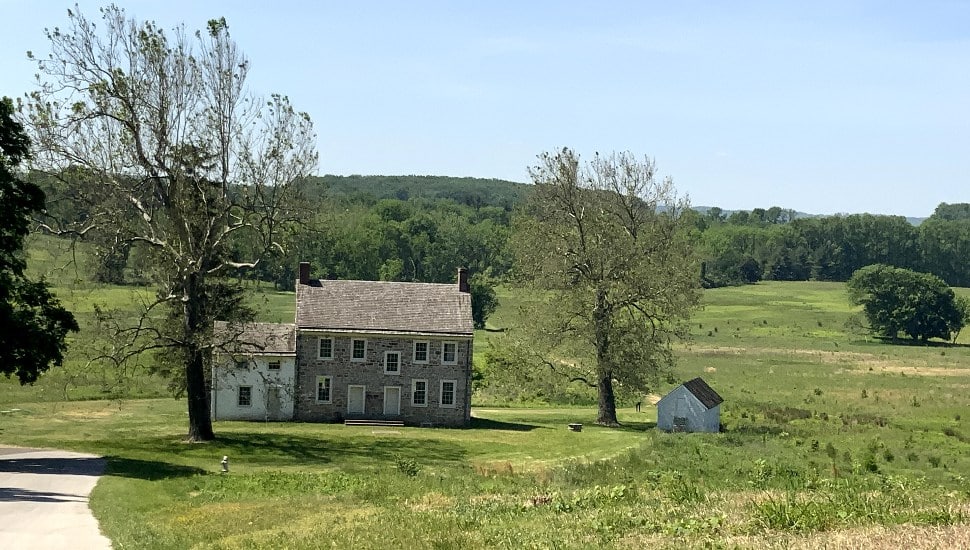
Stand anywhere in the Delaware Valley and you’re standing on Revolutionary ground.
In Philadelphia, the Continental Congress met in Independence Hall to debate, draft, and ultimately sign the Declaration of Independence, the document that changed the world.
In Chester County, thousands of troops clashed at the Battle of Brandywine, the largest single-day battle of the American Revolution, and, for its time, the most costly ever fought on American soil.
Montgomery County bore witness to Valley Forge, where endurance, faith, and frostbite forged the army that would win independence.
To the north in Bucks County, General George Washington and his exhausted band of Continental soldiers crossed the icy Delaware on Christmas night, striking British troops stationed in Trenton and changing the war’s course.
And in Delaware County, quiet farms and mills supplied the powder, food, and shelter that kept the fight alive.
These places aren’t distant landmarks on a classroom map. They’re the neighborhoods, parks, and trails we drive by and walk on every day.
The same roads that carry our morning commute once carried messengers and muskets. The same courthouses where we settle disputes once echoed with debates about liberty and loyalty.
The Revolution happened right outside our windows, and its story belongs to every one of us.
The Civil War Before the Civil War
Burns calls the Revolution “as bloody per capita as our Civil War.” He’s not exaggerating. The Revolutionary War tore apart communities just as the North-South conflict would nearly a century later.
British loyalists fled to Canada; American loyalists confiscated their homes. Both sides harassed Quaker farmers who refused to fight.
Native Americans and free as well as enslaved Africans were forced to choose alliances that rarely led to safety or freedom.
Seen through that lens, the Revolution becomes not just a war for independence but a civil war over identity; who counted as American, whose freedom mattered, and what unity would look like once the shooting stopped.
In that sense, Burns’s story feels eerily familiar. We’re still arguing, in different ways, about the same things: who we are, who belongs, and how we hold together when our differences threaten to pull us apart.
Lessons for a Polarized Nation
Every generation faces its own kind of revolution. Ours may not be fought with muskets and bayonets, but with social media posts, algorithms, misinformation, and mistrust.
Burns says his goal isn’t to preach patriotism but to foster perspective and to remind us that division isn’t new, and that democracy has always been fragile.
In 1776, people risked their lives for an idea that had never been tried at such scale: self-government. Today, we’re asked to keep that idea alive, not by marching to war, but by listening, voting, and participating.
Remembering the Revolution as both inspiration and cautionary tale might be exactly what this moment needs.
What Revolutionary November Includes
All month long, we’ll bring that story home to the Delaware Valley. Here’s how:
- Daily Stories: Every day we’ll spotlight a Revolutionary event, person, site, or theme tied to our region, from forgotten skirmishes to enduring landmarks.
- Interactive Archive: A top-of-page banner links to each county’s growing archive of Revolutionary War stories, profiles, and videos.
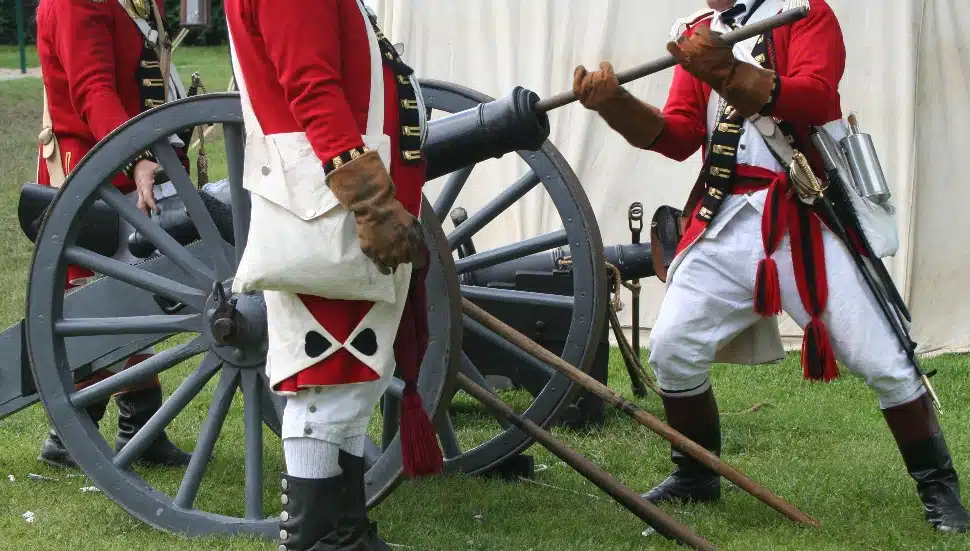
- Community Voices: We’d love to hear from you. Share photos of local monuments, re-enactments, or even family lore tied to the Revolutionary War era on social media. Use the hashtag #RevolutionaryNovember so we can feature, share, and boost your post.
Why This Story Still Matters
The American Revolution was about more than breaking away from Britain. It was about becoming something new.
Burns often says that the Revolution made us “citizens, not subjects.” That’s not just a clever turn of phrase; it’s a reminder that freedom isn’t a spectator sport. Citizenship carries responsibility: to stay informed, to care, to show up, and to participate.
The colonists of 1776 didn’t agree on everything. In truth, they agreed on very little. But they shared a belief that the experiment was worth the risk. They argued, they doubted, they bled, and somehow they built a country that could argue, doubt, and still keep trying.
That tension is part of our DNA. It’s what keeps us striving toward a more perfect union.
Join the Conversation
So this November, as The American Revolution unfolds for six nights beginning on November 16th, we invite you to experience it alongside us.
Follow our daily stories, answer the trivia, walk the battlefields and parks that made history, and rediscover the ideals that still define us.
Because the Revolution that started in our fields, pubs, and halls and ended at Yorktown, continues every time a community debates its future, every time a neighbor lends a hand, every time one of us chooses hope over despair.
The promise of the American Revolution that began outside our windows still lives here; in every act of courage, every vote cast, and every voice that believes the story of America, like all great stories, is still being written.
.