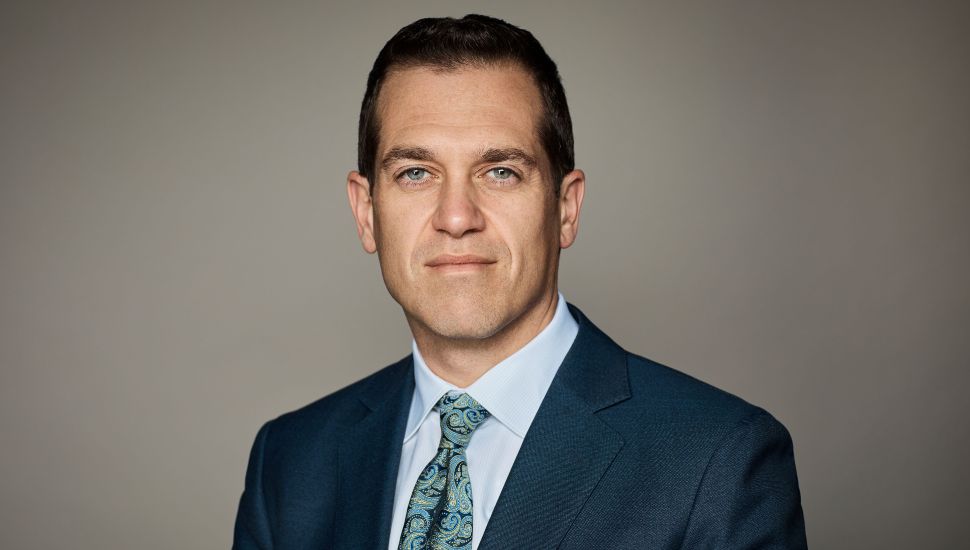

Mike Vennera, Executive Vice President and Chief Strategy, Technology, and Operations Officer of Independence Blue Cross (IBX), spoke with PHILADELPHIA Today about his childhood in Montgomery County, learning the value of hard work in his parents’ restaurant, playing football, and becoming the first in his family to attend college.
After studying English literature, Vennera realized that a career in academia was not the right fit for him. He pivoted and landed a job with Independence Blue Cross, where he applied his strong communication, strategic thinking, and multitasking skills. After a number of roles at the company, Vennera is now a member of the executive team for IBX, the region’s leading health insurer. He shared how his relationship with technology has evolved over the years, the innovations he’s proudest of, and how he maintains his optimism by connecting with others face to face.
Where were you born, and where did you grow up?
I am the youngest of two children and was raised in the Philadelphia area — Montgomery County specifically. I grew up right outside of Ambler in Whitpain Township, and then in Gwynedd Valley.
What did your parents do?
My dad worked at an asbestos factory. That was the main industry in Ambler at the time. And my parents owned a restaurant that my mom operated. She was the cook for her whole career at the restaurant.
Did you work at the restaurant?
Yes, working at the restaurant was a rite of passage for not just my immediate family, but the extended family. Everyone did a tour of duty.
I think I did every job in the place, except for waiting tables. I spent most of the time cooking, especially as I got older and was home for the summers from college.
What do you think your parents taught you at the restaurant that still influences how you work?
Working at the restaurant taught me how to multitask. When you’re working in a restaurant kitchen, you have rush times, and you get 20 or 30 checks lined up. You must learn how to handle multiple orders at once — cracking eggs for one order, pouring pancakes for another, dropping fries for the third, and so on.
And that is a lot like what you do as an executive. I lead multiple areas and different projects at IBX, and I often have to adjust from meeting to meeting throughout the day. In many ways, it’s like a different version of working in a fast-paced kitchen.
What do you think you took from them that is still part of your personality and work ethic today?
They were always hard workers, so I definitely learned that value from them. My dad’s dad came over from Italy. The rest of my grandparents were born here, but their parents came over from Italy as well. So, immigrants two generations back at the most.
Did you play any sports when you were growing up?
I loved sports. In high school, I played football, which was the sport I always wanted to play.
My family was a big football family. As a child, my dad used to go out in the driveway and punt footballs and have me receive them. I played a bit of T-ball and soccer when I was young, but I never really got into those.
I played offensive line for the high school football team. People who know me may be surprised at that, but I was about 40 pounds heavier than I am now in high school. One thing that was formative for me was that I worked hard to make the team, got an opportunity to play varsity when I was a senior, and then broke my hand a couple of games into the season, so I missed most of the season.
I’m going to assume you were a pretty good student. You could have gone to college anywhere. I saw that you went to Penn State, but where else did you look at besides Penn State?
Now that I have kids who are starting to go through the college process, I look back and wonder how I even made it into a college. Not because I wasn’t a good student — I was a very good student — but neither of my parents went to college. I was the first one in the immediate family to attend college and had to just figure it out.
When it came down to it, there was the choice between Dartmouth and Penn State, and it was financial at that point. My parents were unable to foot the bill for a school like Dartmouth, so I ended up going to Penn State.
Was Penn State the right choice for you in hindsight?
It ended up being a very good fit. I have nothing but good things to say about Penn State. That’s where my son is now.
I was in the honors program there, which is like a school within the school, so that made it feel very manageable. I had some of the giant classes that you take at Penn State, but a lot of my classes were much smaller.
Did you do an MBA or a graduate program afterwards?
I had an interesting journey of how I got into the business world. At Penn State, I ended up majoring in English, and my intention was to go into academics. After Penn State, I enrolled in a doctorate program at the University of Pennsylvania in comparative literature.
I was on the track to be a Literature professor and then realized, for a couple of reasons, that it wasn’t a good fit. It was a terrible job market. I had maybe romanticized the idea as a student, and then when I saw what the field of academics is really like, I decided it wasn’t for me. That’s what led me to Independence Blue Cross, where I’ve now worked for 27 years.
What are your current projects? What are you spending your time on?
We’re at the tail end of a very large technology project, where we are changing a number of our core operating systems and platforms. That’s been going on for a couple of years. Hopefully, someday, I can say that’s the project I’m most proud of.
I have the operational side of my role, but also the strategy side. We’re working on a new strategic plan for the organization to take us through 2030.
What project are you proudest of?
There have been so many I’ve worked on, it’s hard to single one out. Some are still in process, so I don’t want to claim victory quite yet.
One memorable project from early in my career was bringing an innovation program into the company. It was an engaging, fun activity that went on for a few weeks. A long-time associate who participated in that came up to me after we were done to say thank you. She said this was the single most rewarding professional experience she had ever had.
That stuck with me. Giving someone with ideas the opportunity to contribute to something bigger was meaningful for me.
How is artificial intelligence impacting you and IBX as a whole?
I’ve been co-leading an industry group on GenAI for the last couple of years. AI is a bit of a moving target. What we call “AI” changes every couple of years. But we’ve had a real effort in the wake of ChatGPT and this whole generative AI revolution to figure out what it means for our organization.
Our first priority was to put in some guardrails to make sure it was used responsibly and ethically. Now we’re continually looking for ways we can use it to better serve our customers.
It’s something that every organization in every industry has to wrestle with, and I expect it to be pretty transformative.
Looking back on your career, who were the people who saw promise in you and opened up doors at IBX?
When I first needed to find a “real job,” I did know a former IBX Executive named Mike Green who knew me as a kid and knew I was a good student. He helped me get in the door of an entry-level position in 1998.
And then, about midway through my time here, circa 2010, another Executive named Yvette Bright, who ultimately became EVP and Chief Operating Officer, saw leadership potential in me and helped get me into a role in corporate strategy. Ultimately, I ended up working for her and then moved into the chief information officer role. She placed a lot of trust in me.
What do you think Yvette saw in you?
My brand, internally, I think, has always been someone who is collaborative. I work well with people and produce good ideas and strong results. My hope is that that reputation is preceding me a little bit and people know I’m a problem solver. It seems I get tapped on the shoulder when someone needs help solving a problem.
Anybody else who saw potential in you?
Both IBX’s prior CEO, Dan Hilferty, and our current CEO, Greg Deavens, have also entrusted me with a lot of unique opportunities that have been very significant along the way. Over the years, I’ve done projects that have been meaningful for the company, so I’m very thankful for the trust they’ve put in me.
What’s something big you’ve changed your mind about over the last 10 to 15 years?
Understanding that technology is a double-edged sword and doesn’t always make things better is the biggest thing that I’ve changed my mind on. It seems pretty clear that there are downsides to some technologies, like social media.
If you’d interviewed me 10 or 15 years ago, I would have been more like, “Hey, technology is going to make everything great.”
What keeps you hopeful and optimistic? It’s a crazy world out there.
What keeps me hopeful and optimistic is all the people that I know. The world does seem crazy, but a lot of that is in the media, in the news. Everyone I know and interact with — and I interact with a fair number of people — is reasonable. They have different opinions about the way things should work in the office, the way the world should work, but for the most part, people get along, and they want the same thing. They want to be prosperous. They want their kids to prosper.
Sometimes, if you’re hidden behind a screen and you’re going through social media, it brings out the worst in people. Just interacting with people face-to-face makes me more optimistic.
What do you do with your free time?
My free time is split between a couple of things. My wife Renee and I have three kids, so I’ve spent a lot of time watching them play sports. They’re all athletes.
I’m back to my roots as an English major. I read a lot. I have a pretty large library at home, and I have a long list of books that I want to get to. One of the best books I’ve read recently is Middlemarch, by George Eliot, which is a 19th-century British novel, set in the Midlands, about British manners at that time.
And I try and do as much hiking as I can. I spend a lot of time in Valley Forge National Historical Park or other nature preserves in the area.
Finally, Mike, what’s the best advice you’ve ever received?
The best advice I’ve received is to spend as much time as you can with your kids when they’re young. I can’t make every game, especially with a demanding job, but I try to prioritize it as much as possible, because I know that I’m not going to get that time back. I’ve really tried to take that advice to heart.