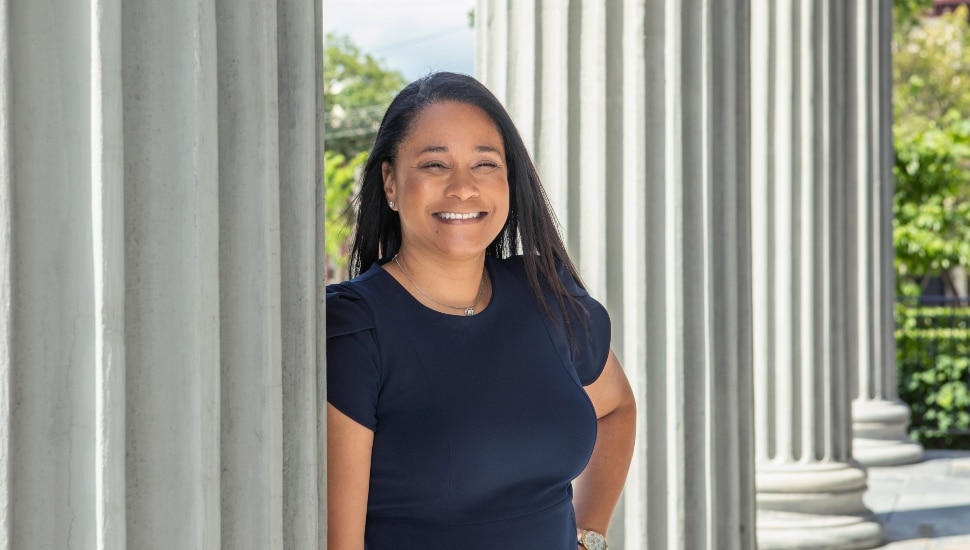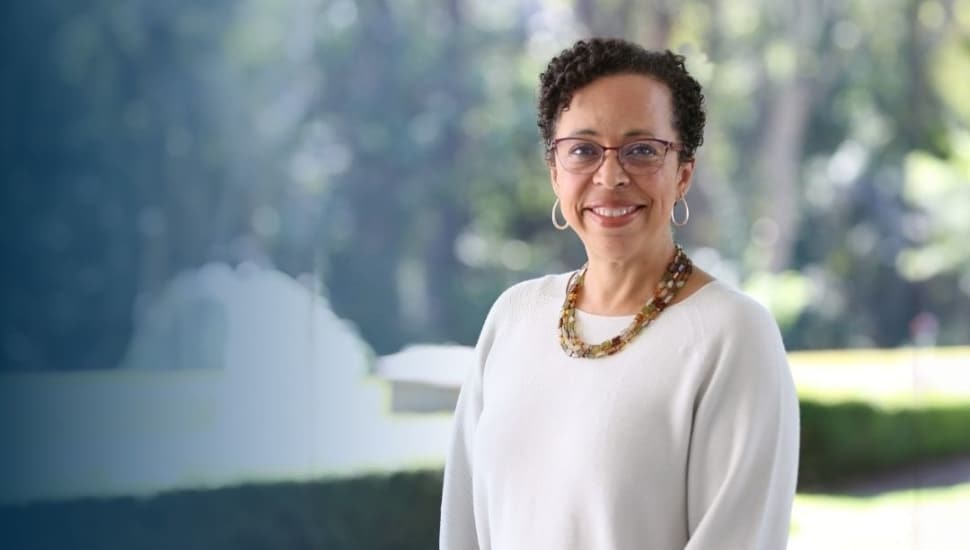

Dr. Nicole Hood, head of school at Abington Friends School, spoke with PHILADELPHIA Today about growing up in Richmond, Virginia, where she was close with her brother, cousins, and extended family. From a young age, she loved reading. She also ran track and cross country in high school, which she enjoyed because of the camaraderie and hard work.
After being a professor, Hood began working in independent schools and realized she wanted to pursue leadership. She discussed what she likes about the Quaker approach to education, the many forms of diversity at Abington Friends School, her plans for a capital campaign, and why she loves working with teenagers.
Where were you born and where did you grow up?
I was born the oldest of two children in Richmond, Va. I lived there off and on throughout my life, so Richmond is still home.
What did your parents do?
My mother was a Teacher when I was growing up, but she ended her career as a Lawyer.
My dad is a City Planner and a Public Administrator. He ended his career as the inspector and director of public works in Los Angeles.
What memories stay with you from growing up in Richmond?
I was always close to my family. My grandmother had three daughters and six grandchildren, so I remember spending a lot of time with my family. My cousins were all older than me, so I looked up to them.
Maybe it’s because we just celebrated Thanksgiving, but whenever I think about growing up, I think about those holidays that I spent with my family. And, of course, spending time with my brother. I loved school as a child. I read a lot from the time I was very young.
Where does that love of reading come from?
I don’t know. I had my mother read Green Eggs and Ham to me over and over until I could read it myself.
When you were a teenager, did you have a favorite author or a favorite book?
I was once an English Teacher, and I taught a whole class on Toni Morrison. I read her book Sula in high school.
Did you do any sports in high school?
I ran track and cross country. I enjoyed running a lot.
How good were you at running?
Not very good; I did it because I loved it. I don’t remember glorious awards. I don’t remember medals. I remember loving being out there, being with a team, being outside, and working hard.
It was a time when we tended to glorify our suffering and the pain of running, which is not great. But I think I was drawn to the discipline and the hardness of it.
What about jobs? Did you have jobs when you were growing up?
I worked a lot of retail jobs in high school. My first job was as a fitting room attendant at Saks Fifth Avenue. I worked at Saks for a while, and all through college I worked retail jobs. I worked at Ann Taylor and a few others.
What did you learn from those jobs, Nicole?
I learned I liked the independence of having my own money. When I was younger, before I started working at Saks, my brother and I would go to my dad on Saturday mornings and be like, “Can we get some money?”
I didn’t like standing there begging him. I realized I wanted more money than he was ever going to give me, so I decided to go out and get a job.
You learn how to treat people in a retail job. I worked at some high-end retail places, so occasionally there would be famous people or people of note who’d come through.
You also learn how people can treat you when you’re cleaning fitting rooms. I learned what it was to be tired at the end of the day.
I got increasing responsibility while at that job. Over time, they moved me to different parts of the store where I did different things. For a while, I was the switchboard operator.
What kind of music floated your boat in high school?
My entire high school and college time was encapsulated in the ‘80s. We listened to a lot of Michael Jackson, Prince, and Whitney Houston. I remember going to see Purple Rain when it came out in 1984 with my friends, standing out there waiting, waiting, waiting, and going to see it again and again and again.
Did you ever go to any concerts?
My parents were very strict. I was not allowed to go to big rock concerts until I was an adult. I would go to some concerts, but they tended to be very tame. If Prince, Michael Jackson, or Janet Jackson were to come to town — Janet Jackson was a hot ticket — I would not have been allowed to go.
Where did you end up going to college and why there?
I went to the University of Virginia. It was important for me to go back home to Virginia, and I applied early.
One of my cousins went to UVA ahead of me, and she could have said it was like a pit, and I still would have been like, “Yeah, I’m going.” I wanted to do everything that she did.
You didn’t apply to any other schools?
Nope. I applied early decision. I got in.
Was it a good choice for you, in hindsight?
It was. My UVA years were important. I made lifelong friends there.
Did you do graduate school afterward?
I graduated from college and worked for a couple of years as a management trainee at a bank.
Again, I wanted the independence of doing my own thing and being able to take care of myself.
Then I went to the University of Michigan. I have a master’s and a doctorate in art history, so I did all the school you can possibly do!
Looking back over your career, who were the people who saw promise in you?
I have to give credit to two mentors. I started working in independent schools around 2007-2008. I’d been doing a lot of things before then. I’d been a professor and pursued the academic route. I started having children — building a family was important to me.
The first school I worked for, St. Catherine’s School, was in my hometown. It’s an Episcopal girls’ school. The woman who hired me, Cathy McGehee, was the upper school director. When Cathy and I met, I didn’t start working at St. Catherine’s right away, but we kept having coffee together. She was like, “I’m going to find a job for you at this school.”
As time went on, Cathy has been a huge mentor to me at every step. She made sure I got those early jobs. She supported me when I started and when I figured out that I was going to pursue leadership in schools. She nominated me to the board for the International Coalition of Girls’ Schools, which she was on. She has been a persistent and consistent mentor for me.
Even before she hired you, she saw something special in you. What do you think she saw?
She saw somebody who loved being in a classroom, who loved the work with teenagers, which I still love to this day. People don’t understand it, but I love hanging out with teenagers. Cathy saw that in me.
I think she saw that my intellectual life was important to me, and that was a big model for the students. I took, and I still take, my intellectual life very seriously. Those two things together, I think, really mattered.
Is there anyone else who saw promise in you?
The Head of School that I just finished working for in Baltimore — Sue Sadler at the Bryn Mawr School.
Sue gave me an opportunity to work as an Upper School Director, which I really wanted to do. She recognized fairly early that I wasn’t going to stay an Upper School Director forever.
At every step that I went to her and said, “I’m thinking about pursuing this opportunity,” she was always in my corner. She tells people all the time she knew from the beginning that I’d be a Head of School.
So, how did you end up at Abington Friends School?
A year and a half ago, the search consultant who was working with the school reached out to me. I’m not a Quaker, and I wasn’t from Philadelphia. I had a couple of conversations with the consultant before, and I thought, “Okay, I’m in on this one.”
But, I’ve got to tell you, this was a different kind of search. I had a different feeling from the very first interview. There is a thoughtfulness to us as a school community. I talked about taking my intellectual life seriously. There’s a seriousness of purpose in this school that matches me exactly.
And my background in Episcopal schools is sort of Quaker-adjacent. My experience had been that when I was working in nonsectarian schools — and the previous two, Bryn Mawr and the one before that, had both been not religiously affiliated — I found that not having that spiritual underpinning to the school community was like an ache that I could not fix.
When the days were really hard at those schools, I would think, “Why can’t we be attached to something more durable, more sturdy, more permanent than this ephemeral moment that we’re in?” It was something that I needed and that informs our day-to-day practice here and, I think, profoundly impacts our students.
So, once I was in on this search, it was easy. Every day I fall a little bit more in love with this place.
And how long have you been on board?
My appointment was announced last October, and I started Jul. 1.
What’s been your biggest surprise?
How much I would feel like the Quaker process is natural. People who know me well anticipated that my natural sort of task orientation, goal orientation, and get-it-done would be an impediment to me in this setting. And yet, again, the purpose and spirit with which we enter decision-making conversations means I feel like it is so natural and worthwhile to approach decision-making the way that we do.
Looking out over the next three to 12 months, what are you focused on? What are your challenges and opportunities, Nicole?
I was fortunate in that Rich Nourie has been an unfailing support system and very generous, so I have been able to spend this year working on building the relationships that will carry the school forward.
We are an intensely relational kind of school, and that is foundational work. I’m very systematic and very clear about how I’m engaging the various constituencies — alums, parents, students, board members, community in general — to make sure that I can do the longer-term work that we’re trying to set ourselves up for.
It’s been a while since the school had a capital campaign. We’re thinking about AFS students and what the needs of AFS students will be 10, 20, or 30 years down the road and making sure that we have the facility to meet the needs of those kids.
So that will be my long-term work and focus, which is why I’m having this glorious year of immersing myself deeply so I can understand who we are, and what we are and speak from a position of real knowledge and expertise when I invite people to come and help us create this space.
We are a unique and special kind of place.
How would you describe it? How do you want Abington Friends to be known?
Ours is a school that deeply values the humanness in every person in our midst. That deep valuing enables us to do things and look at our relationships with one another in ways that get beyond the kind of interpersonal strife that we have in the world.
We’re among the most diverse independent schools that you can find anywhere, in terms of socioeconomic diversity, racial diversity, ability, and gender identity.
And yet our conversations, our engagements, and our practices with one another seek to connect deeply, one to another, as human beings. It sounds idealistic; it sounds impossible when you think about the world we live in and the resentment and contention that we have in the world.
And yet, I’m committed to making sure that this is a place where that whole mix of diversities and identities and humanities not just coexist together, but learn together and thrive together.
What do you do with all your free time, Nicole?
I’ve got two kids. One is in North Carolina, the other is in college. I’m hoping to go visit both of them in 2025. I still love to read, so I read novels a lot.
Do you have a favorite author?
Ann Patchett is one that I’ve loved a lot. Elizabeth Stroud is another one. The Heaven and Earth Grocery Store by James McBride was my favorite book in 2024, bar none.
And I knit because that’s a way for me to calm myself.
Three last questions for you, Nicole. What’s something big that you’ve changed your mind about over the last 10 years?
For a long time, I was skeptical of teachers and folks who said academic excellence, academic accomplishment, is flexible — that people can grow into things. I see people learn and make contributions to communities that, in an earlier iteration of my life, I wouldn’t have been able to predict or envision. I’ve learned not to judge a book by its cover, and not to be quick to judge.
What keeps you hopeful and optimistic in today’s world?
Honestly, it’s these kids. If you work here at this space with these kids, they’re grappling with all of it. And yet they say things, they do things, they tell us about our beliefs in a way that you can’t help but be hopeful or optimistic.
I’ve spent some time trying to say to folks, again, in this contentious moment that we live in, when we were young people, nobody came and told us that the world was ending, right? They didn’t come and rob us of our hopes for the future.
When external forces are saying there’s every reason to be hopeless, our task is to ensure that kids stay hopeful about their future. And when we do that, the future actually becomes hopeful.
Finally, Nicole, what’s the best advice you’ve ever received?
When my oldest daughter was a baby, we watched Finding Nemo over and over. One character, Dory, had a simple yet powerful mantra: “Just keep swimming.” No matter what, don’t give up — just keep moving forward.
Even when things look bleak, half of the battle is just showing up in whatever condition you can. If you show up and if you keep going, you can’t fail.